When you live in Japan, there are hundreds of little things you stop noticing.
Taking off your shoes.
Carrying your trash home.
Standing on a quiet train surrounded by people.
Buying a hot drink from a vending machine on a cold morning.
For Japanese people, these things can feel completely ordinary.
But when friends from other countries visit Japan, sometimes the things that surprise them most aren’t temples, technology or giant cities.
They’re the small details of everyday life.
So here are 10 things that feel completely normal in Japan — but might make you stop and think, “Wait… you do that every day?” 🇯🇵
Welcome to REAL LIFE.
- 01. Taking Your Shoes Off Indoors
- 02. Convenience Stores Are Actually Convenient
- 03. Trains Can Be Surprisingly Quiet
- 04. People Carry Their Trash With Them
- 05. Leaving Things Unattended
- 06. Wet Umbrellas Have Their Own Rules
- 07. Slurping Noodles Isn’t Rude
- 08. Hot Drinks From a Vending Machine
- 09. Eating While Walking Isn’t Always the Norm
- 10. Saying “Otsukaresama” All the Time
- Final Thoughts
01. Taking Your Shoes Off Indoors
One of the first things many visitors notice in Japan is how often people take off their shoes.
At home, this is completely normal.
You enter through the genkan — the small entrance area — take off your shoes, and step up into the house without them.
But the habit doesn’t stop at home.
You may also be asked to remove your shoes at traditional ryokan, some restaurants, temples, clinics, fitting rooms and other places with tatami or raised floors.
🏠 WHY?
There’s a simple idea behind it: outside dirt stays outside.
The genkan acts as a boundary between the outside world and the clean living space inside.
👀 WHAT TO LOOK FOR
If you see a raised floor, slippers lined up near the entrance, or other people taking off their shoes, that’s usually your clue.
And one important detail: try not to step onto the clean indoor floor with the same foot that is still wearing an outdoor shoe.
💡 KAI’S TIP
When you’re not sure whether to take your shoes off, just look around.
Japanese people do exactly the same thing in unfamiliar places. 😂
Watch what everyone else is doing — and follow their lead.
02. Convenience Stores Are Actually Convenient
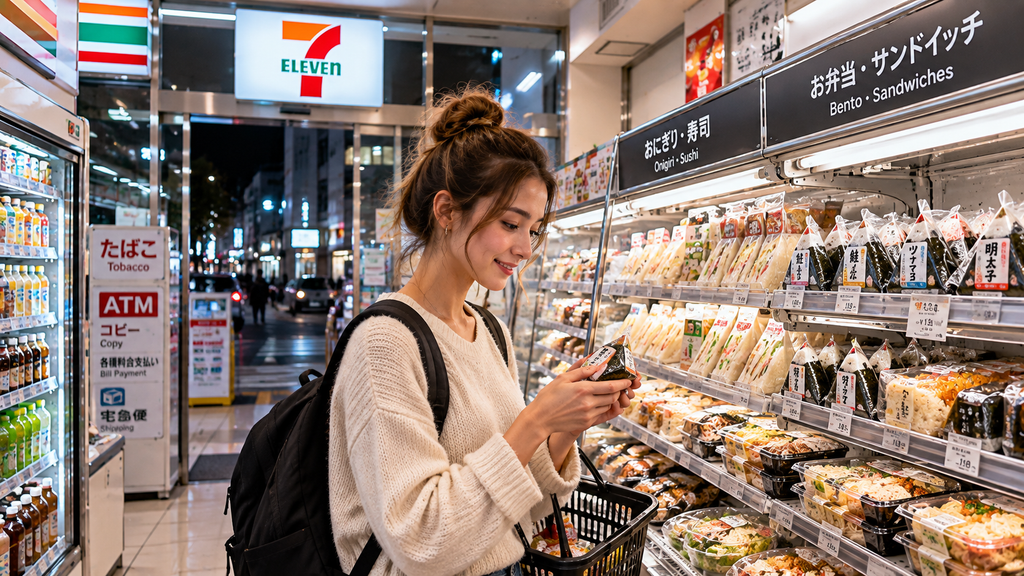
In Japan, a convenience store isn’t just somewhere to grab a drink or a snack.
For many people, it’s part of everyday life.
At stores like 7-Eleven, FamilyMart and Lawson, you can buy surprisingly good meals, coffee, toiletries, stationery and things you suddenly realize you need at 11 PM.
But that’s only the beginning.
🏪 MORE THAN A STORE
Depending on the location and service, you may be able to use an ATM, print or copy documents, pay bills, buy tickets, send packages and pick up online orders.
And of course, there’s the food.
Onigiri, bento, sandwiches, noodles, desserts and seasonal items make Japanese convenience stores especially fun for first-time visitors.
👀 WHAT TO TRY
Don’t just grab the first thing you recognize.
Look around the refrigerated shelves and seasonal displays. You’ll often find foods and flavors that change throughout the year.
💡 KAI’S TIP
If you arrive in Japan late at night and everything feels unfamiliar, a convenience store is one of the easiest places to start.
Get an onigiri, something to drink, and maybe one snack you’ve never seen before.
Congratulations — your first tiny Japanese adventure has begun. 😂🇯🇵
03. Trains Can Be Surprisingly Quiet
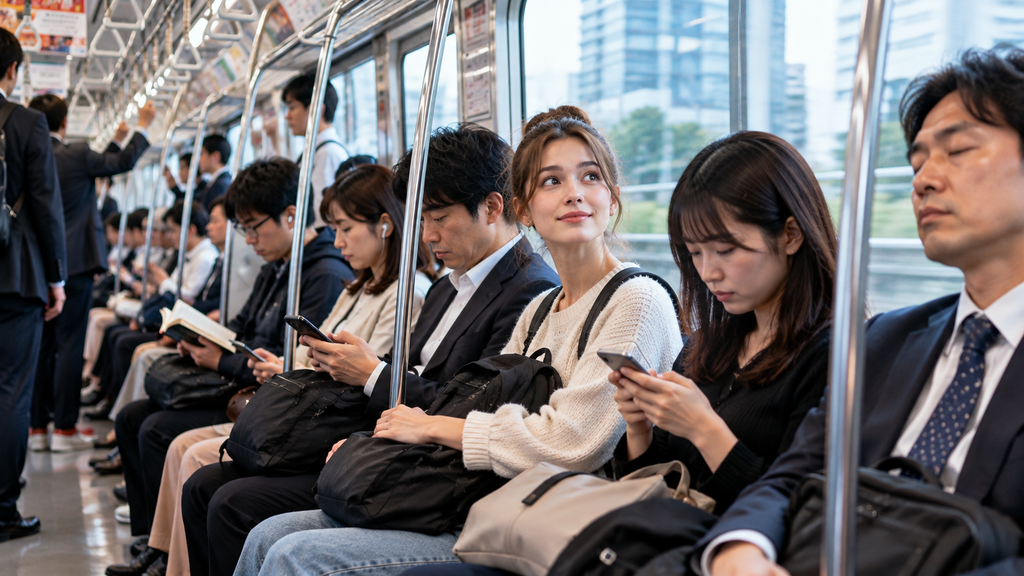
Tokyo trains can be packed with people.
And yet, one of the first things you may notice is how quiet they can be.
People talk, of course, but loud conversations are generally uncommon. Most passengers are looking at their phones, reading, sleeping or simply sitting quietly.
Even on a crowded train, the atmosphere can feel surprisingly calm.
🚃 WHY SO QUIET?
In Japan, public transportation is a shared space, and there is a strong tendency to avoid disturbing the people around you.
That’s also why you’ll often see signs asking passengers to set their phones to silent mode and avoid making phone calls inside the train.
👀 WHAT TO KNOW
You don’t need to stay completely silent.
Talking quietly with someone is perfectly normal.
The important thing is simply being aware of your volume and the people around you.
💡 KAI’S TIP
If your phone rings on a crowded Tokyo train, you probably won’t be arrested. 😂
But you may suddenly become the most noticeable person in the carriage.
Put your phone on silent mode before boarding and enjoy one of those strangely peaceful Tokyo train rides.
04. People Carry Their Trash With Them
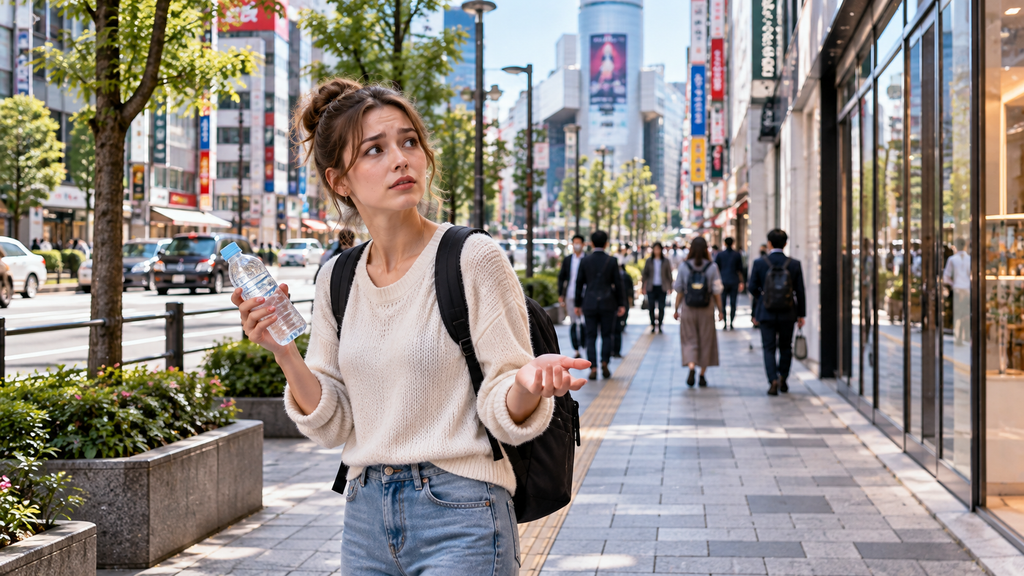
You might notice something strange while walking around Japan.
The streets can be remarkably clean — but public trash cans aren’t always easy to find.
So where does all the trash go?
Quite often, people simply carry it with them until they find an appropriate place to throw it away.
🗑️ FEWER TRASH CANS THAN YOU MIGHT EXPECT
Depending on where you are, you may find bins at convenience stores, train stations or beside vending machines, but you shouldn’t assume there will always be one nearby.
And Japan takes separating waste seriously, so one bin isn’t necessarily for everything.
👀 WHAT TO KNOW
If you buy street food or a drink, it’s a good idea to think about where you’ll dispose of the packaging afterward.
Sometimes the easiest option is to keep a small bag in your backpack and carry your trash until you find the right bin.
💡 KAI’S TIP
When exploring Japan, I recommend carrying one small plastic bag with you.
It weighs almost nothing and can save you from walking around Tokyo for 30 minutes holding an empty coffee cup. 😂
One of the funny things about Japan is that you may spend more time looking for a trash can than looking for a convenience store.
05. Leaving Things Unattended
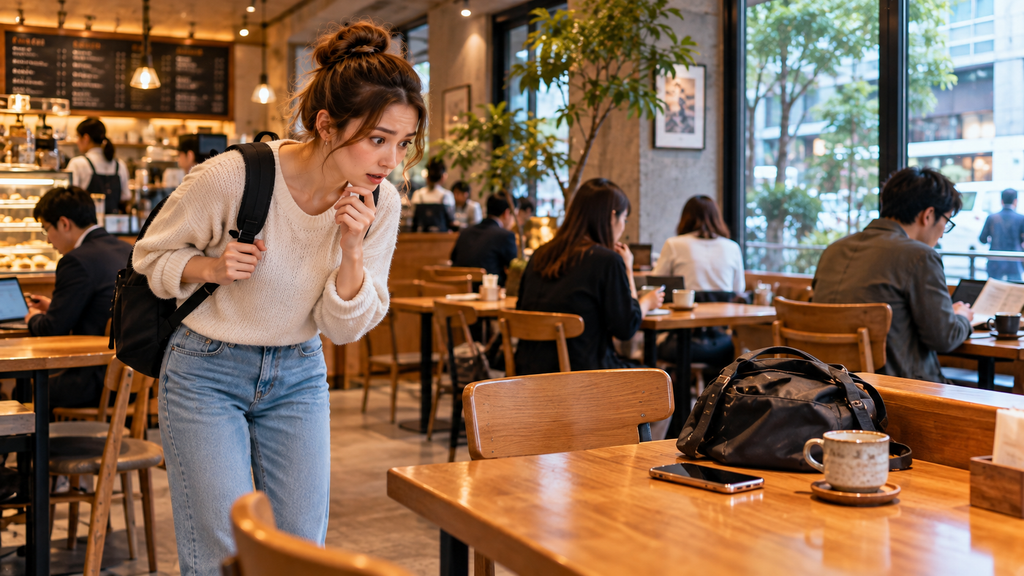
Here’s something that can surprise visitors to Japan.
You walk into a café and see a phone, bag or laptop sitting on a table.
But there’s nobody there.
The owner may simply be ordering a drink, using the restroom or saving the seat.
🎒 IS THAT REALLY NORMAL?
Leaving belongings unattended is something you may see in cafés, food courts and other everyday situations in Japan.
There’s generally a high level of trust in public spaces, so people may feel comfortable doing things they wouldn’t consider elsewhere.
But that doesn’t mean theft never happens.
Japan is not a magical place where nothing ever gets stolen. 😂
👀 WHAT TO KNOW
You might also notice people using a small personal item to show that a seat is taken.
A bag, handkerchief or other belonging can quietly mean:
“This seat is mine — I’ll be back.”
💡 KAI’S TIP
It’s interesting to observe this part of everyday Japanese life, but as a traveler, you don’t need to copy everything you see.
Keep your passport, wallet, phone and other valuables with you.
Enjoy the sense of trust — without testing it with your passport. 😂
06. Wet Umbrellas Have Their Own Rules
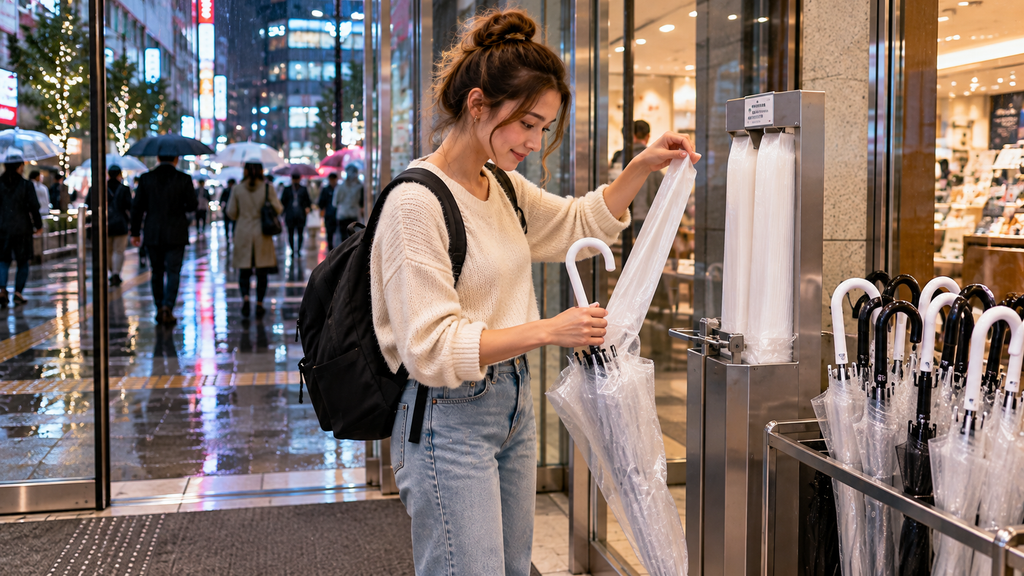
Rainy days in Japan come with a small piece of everyday etiquette that visitors may not expect.
When you enter a shop, restaurant or office with a wet umbrella, you’ll often find something waiting near the entrance.
It might be an umbrella stand.
Or it might be a dispenser filled with long plastic umbrella bags.
☔ WHY?
The idea is simple: don’t bring rainwater into the building.
A dripping umbrella can make floors wet and slippery, so people usually try to contain the water before walking inside.
In some places, you may also find umbrella dryers or reusable covers instead of disposable plastic bags.
👀 WHAT TO LOOK FOR
When entering a building on a rainy day, take a quick look near the entrance.
If everyone is putting their umbrellas into a stand, bag or drying device, follow their lead.
Just remember which umbrella is yours. 😂
💡 KAI’S TIP
Japan’s clear plastic umbrellas all look almost identical.
If you leave yours in a crowded umbrella stand, remembering exactly where you put it can suddenly become the hardest challenge of your day.
A small umbrella marker or distinctive handle can be surprisingly useful.
07. Slurping Noodles Isn’t Rude
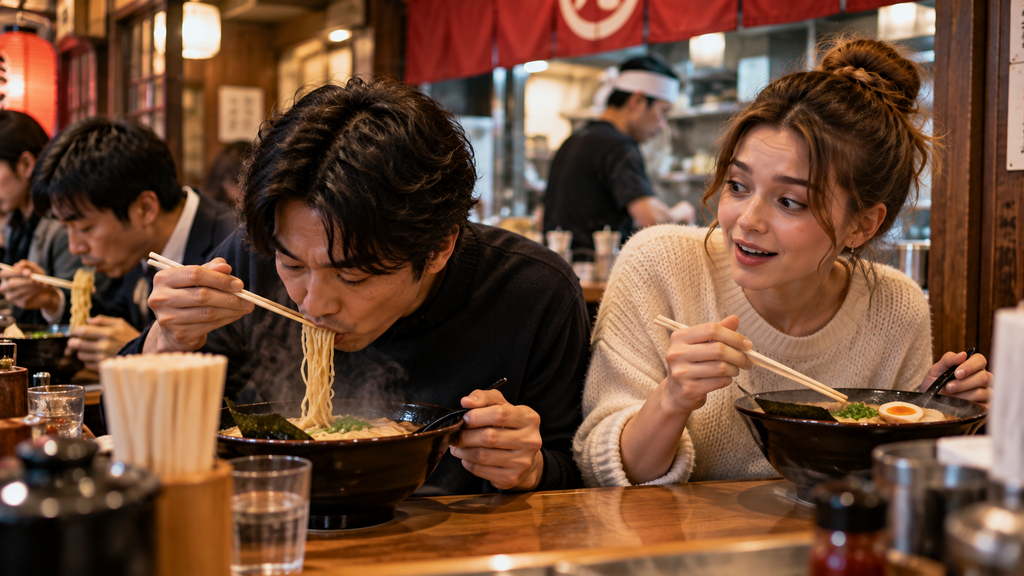
You’re sitting in a small ramen shop in Japan.
Then the person next to you lifts their noodles and—
SLUUURP. 🍜
If you come from a culture where making noise while eating is considered rude, this can be a little surprising.
In Japan, however, slurping noodles such as ramen, soba and udon is completely normal.
🍜 DO YOU HAVE TO SLURP?
No.
Despite what you may have heard, you don’t need to slurp your noodles to show appreciation for the food.
Some Japanese people slurp loudly, some quietly, and some hardly at all.
It’s simply an ordinary way of eating noodles here.
👀 WHY DO PEOPLE DO IT?
Slurping can help bring noodles and air into your mouth together, and it can also make very hot noodles easier to eat.
But most Japanese people probably aren’t thinking about the science while eating lunch.
They’re just eating noodles. 😂
💡 KAI’S TIP
Don’t force yourself to make a huge slurping sound just because you’re in Japan.
Eat naturally.
But if the person sitting next to you sounds like they’re vacuuming up their ramen, don’t worry.
Everything is normal. 😂🍜
08. Hot Drinks From a Vending Machine
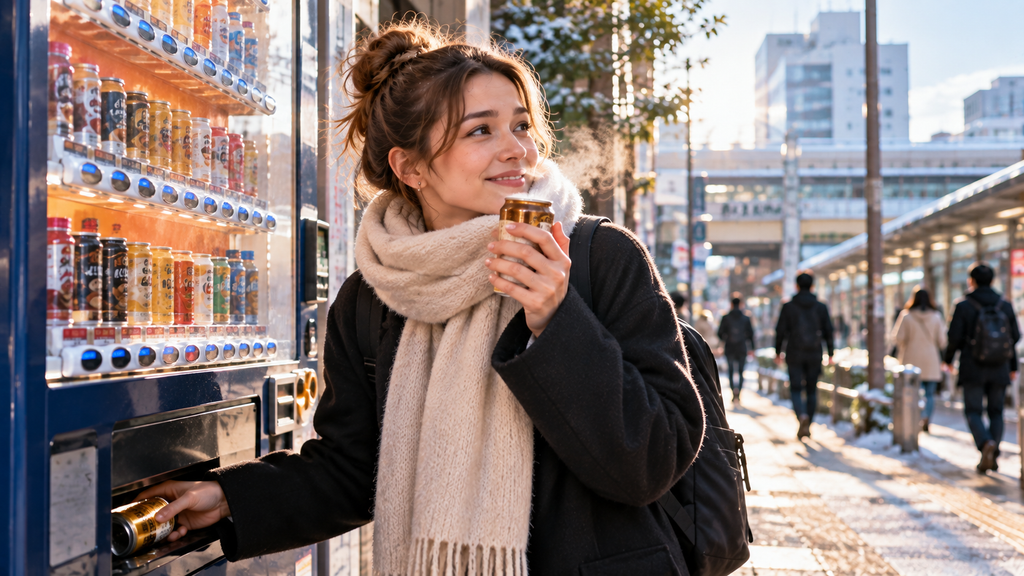
Vending machines are everywhere in Japan.
But when the weather gets colder, you may discover something that surprises first-time visitors:
Some of those drinks are hot. ☕️
Yes — the can or bottle that drops out of the machine can actually be warm enough to heat your hands.
🔥 LOOK FOR “あったか〜い”
Many vending machines separate cold and hot drinks.
Cold drinks are usually marked 「つめた〜い」 or COLD, while hot drinks may be marked 「あったか〜い」 or HOT.
Depending on the machine and season, you might find hot coffee, tea and other warm drinks.
👀 IT CHANGES WITH THE SEASONS
The selection in Japanese vending machines isn’t always the same throughout the year.
As temperatures drop, more warm drinks tend to appear.
That small seasonal change is something Japanese people barely think about — but it’s one of those tiny details of everyday life in Japan.
💡 KAI’S TIP
On a cold morning, buy a hot canned coffee before walking around the city.
Drink it eventually, of course.
But first?
Keep it in your hands for a few minutes. 😂☕️
Congratulations. You’ve just discovered the unofficial second function of a Japanese vending machine: a pocket-sized hand warmer.
09. Eating While Walking Isn’t Always the Norm
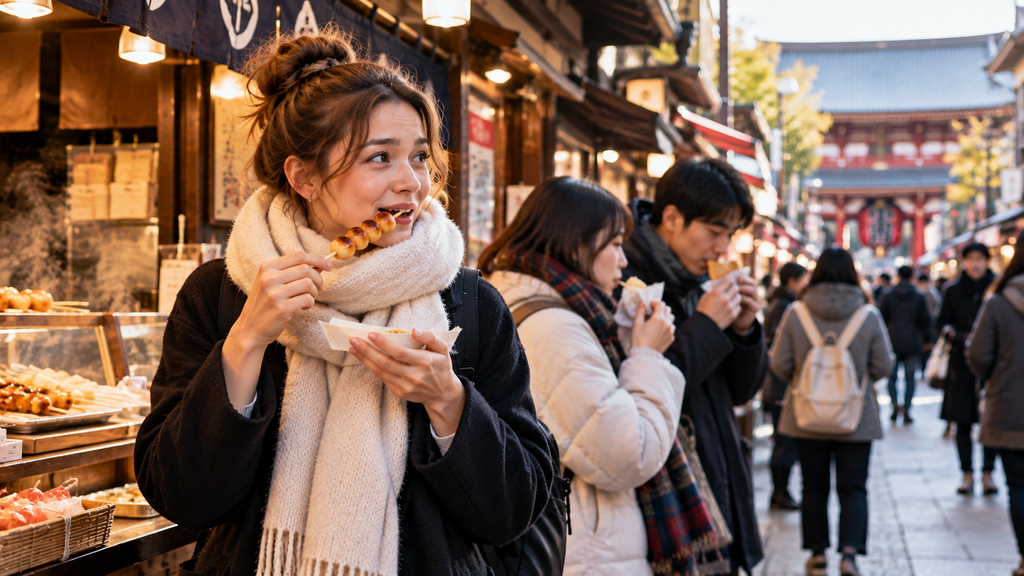
You buy something delicious from a shop in Japan.
Your first instinct might be to open it and keep walking while you eat.
But look around and you may notice something:
Many Japanese people stop somewhere to eat instead.
🍡 IS EATING WHILE WALKING RUDE?
Not necessarily.
There isn’t one universal rule saying you must never eat while walking in Japan.
It depends on the place and situation.
At festivals, tourist areas and streets known for food, eating as you explore may be common — although some busy areas ask visitors not to walk while eating.
👀 WATCH THE LOCALS
If people are standing near the shop and finishing their food before moving on, that’s a good clue to do the same.
This also makes it easier to return wrappers, skewers or cups to the shop when public trash cans are difficult to find.
💡 KAI’S TIP
Don’t memorize a complicated list of Japanese food rules.
Just look around.
Are people walking with their food?
Or are they standing beside the shop eating it?
Follow the atmosphere of the place.
That little habit will help you fit in far better than trying to remember 100 rules from a travel guide. 😂
10. Saying “Otsukaresama” All the Time
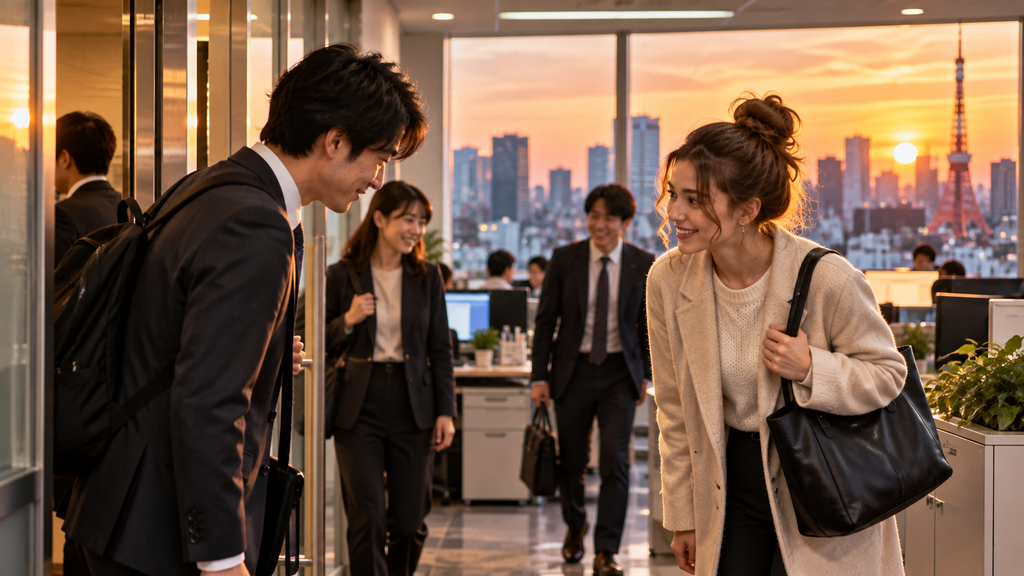
There’s one Japanese expression you can hear almost every day — especially at work.
「お疲れさまです。」
Otsukaresama desu.
Translate it literally and things get a little strange.
“You must be tired.”
But that isn’t really how Japanese people use it.
WHAT DOES IT ACTUALLY MEAN?
Depending on the situation, otsukaresama can feel like:
“Good work.”
“Thanks for your effort.”
“Thanks for today.”
“See you.”
Or sometimes simply, “Hey.”
Coworkers might say it when they pass each other in the hallway, finish a meeting, send a message, or leave work for the day.
There isn’t one perfect English translation.
And that’s exactly what makes it so Japanese.
👀 LISTEN FOR IT
If you spend time around Japanese workplaces, you’ll probably hear 「お疲れさまです」 again and again.
A slightly more casual version is:
「お疲れさま。」
Otsukaresama.
And between friends or close coworkers, you may even hear:
「お疲れ!」
Otsukare!
💡 KAI’S TIP
You don’t need to fully understand every nuance before using it.
If someone has just finished work, completed something, or helped with a task, 「お疲れさまです」 is usually a very natural thing to say.
The funny part?
After living in Japan long enough, you stop translating it completely.
Someone says:
「お疲れさまです!」
And your brain simply replies:
「お疲れさまです!」
Welcome to Japanese everyday life. 😂
Final Thoughts
Japan isn’t only about temples, anime, sushi or famous tourist spots.
Sometimes the most interesting parts of Japan are much smaller.
Taking your shoes off at the entrance.
A surprisingly quiet train.
Carrying an empty bottle because you can’t find a trash can.
Holding a warm canned coffee on a cold morning.
Hearing 「お疲れさまです」 for the tenth time that day.
None of these things will appear on a list of Japan’s “must-see attractions.”
But together, they’re part of what everyday life here actually feels like.
When you visit Japan, don’t only look for famous places.
Watch what people do.
Notice the little habits.
Walk through ordinary neighborhoods.
Step into a convenience store.
Listen to the language around you.
That’s where another side of Japan begins to appear.
Not just the Japan people come to see.
The Japan people actually live in.
— Kai
Kai’s Real Japan